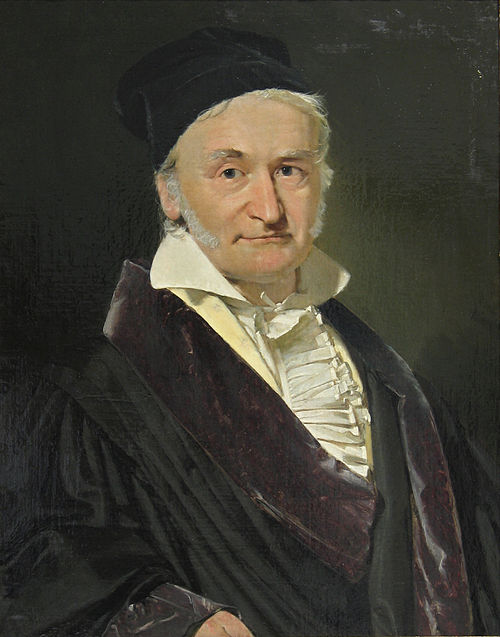
 01 / 1777–1855
Johann Carl Friedrich Gauss
Johann Carl Friedrich Gauss (1777–1855) was a German mathematician and physicist whose contributions were so broad and profound that he became known as the "Prince of Mathematics." His genius became apparent at a very early age and, with the financial support of a duke, he studied in Braunschweig and Göttingen. From a young age, he was associated with stories symbolising his intelligence, such as calculating the sum of 1 to 100 extremely quickly, but what characterised him most was his perfectionist approach to work: he only published when he considered the result complete and perfectly documented, with the motto "few, but mature." In his scientific career, he touched on almost every central field of mathematics of his time. He proved the Fundamental Theorem of Algebra, while with Disquisitiones Arithmeticae he laid the foundations of modern number theory and opened up avenues that still define the subject. He also had an early intuition about the asymptotic distribution of prime numbers and made significant contributions to algebra, complex analysis, geometry, and differential geometry, with the Theorema Egregium on curvature being a prime example. At the same time, he also worked in applied fields such as astronomy, terrestrial magnetism, and geodesy. He was a teacher and mentor to figures such as Riemann and Dedekind, married twice and had six children, and after his death his brain was preserved and studied, as yet another sign of the legend that followed him.
 02 / 1912–1954
Alan Turing
Alan Turing (1912–1954) was born in London and was a mathematician and pioneer in logic, cryptanalysis, and computer science. With his historic work in 1936, he laid the foundations of computability by introducing the "Turing machine," a pure mathematical model of what an algorithm is and what can or cannot be computed. During World War II, at Bletchley Park, he made a decisive contribution to "breaking" the Enigma with decryption machines, while after the war he worked on the first electronic computers and formulated ideas that paved the way for artificial intelligence through the "Turing Test." His life was marked by the persecution of homosexuality in his time. He died in 1954 and was posthumously awarded a royal pardon in 2013. Modern computing and the idea of a "program" are based on the concepts that he was the first to make rigorous and universal.
 03 / 1882–1935
Emmy Noether
Emmy Noether (1882–1935) was a leading German mathematician and one of the most influential figures of the 20th century, with a decisive contribution to modern algebra and theoretical physics. Born in Erlangen, at a time when women found it difficult to obtain academic positions, she studied mathematics and worked for years without official status, until she established herself in Göttingen alongside names such as Hilbert and Klein. In 1918, she formulated the famous Noether's theorem, which links the symmetries of a physical system with conservation laws, the foundation of modern physics. In mathematics, she radically changed the way of thinking in abstract algebra, especially in the theory of ideals and rings, opening up avenues that determined the subsequent development of the field. In 1933, she was expelled by the Nazis because of her Jewish ancestry and emigrated to the US, where she died in 1935. Much of modern algebra and mathematical physics "speaks" the language that she essentially built.
 04 / 1856–1922
Andrey Markov
Andrey A. Markov (1856–1922) was a Russian mathematician who left an indelible mark on probability theory, establishing a central category of stochastic processes: Markov chains. He was born in Ryazan and, despite serious health problems from an early age, studied at the University of St. Petersburg, where he was greatly influenced by Chebyshev. He initially worked on differential equations and number theory and obtained his doctorate in 1884, He then taught for decades at the same university, with a reputation as a strict but demanding teacher who pushed his students not to take anything for granted. In 1906, he introduced Markov chains, i.e., sequences of random variables where the "next step" depends only on the present state and not on the entire past. With this framework, he was able to study limit theorems in cases of dependence and essentially paved the way for the systematic development of stochastic processes, which were later developed by figures such as Kolmogorov and Wiener. Although he was mainly interested in pure theory rather than applications, he was curious to try out his ideas even in poetry, examining transitions between vowels and consonants.
 05 / 1872–1970
Bertrand Russell
Bertrand Arthur William Russell (1872–1970) was a British mathematician, logician, philosopher, and public intellectual who had an enormous influence on both the foundations of mathematics and analytic philosophy. After studying at Trinity College, Cambridge, he turned to mathematical logic and developed the famous "Russell's paradox," which revealed deep problems in the then-intuitive definitions of set theory. Through his philosophical program of logicism, he collaborated with Alfred North Whitehead on the monumental effort to formally found mathematics, which resulted in the three-volume Principia Mathematica, a landmark work for modern logic, even though contemporary set theory and its symbolism have evolved differently. In his academic life, he was closely associated with Ludwig Wittgenstein, whose supervisor he was, and was influenced by the Tractatus, among other things leading him to texts such as The Philosophy of Logical Atomism. At the same time, Russell had a strong political and activist presence: he was imprisoned for his pacifist activities during World War I, and later advocated for nuclear disarmament and against the Vietnam War, co-signing the Russell–Einstein Manifesto in 1955. In 1950, he was awarded the Nobel Prize in Literature for his overall work and his defense of freedom of thought. He died in 1970, at the age of 97, leaving behind a rare blend of rigorous logic, philosophical clarity, and public engagement.
 06 / 1789–1857
Augustin-Louis Cauchy
Augustin-Louis Cauchy (1789–1857) was a French mathematician, engineer, and physicist, one of the most influential figures of the 19th century, who made an enormous contribution to calculus and complex analysis. He produced an impressive body of work, with hundreds of publications and several books, in so many fields that it later became almost a joke that "there is a Cauchy theorem everywhere." The Cours d'Analyse was a turning point for mathematical rigour: it brought to the fore the systematic use of inequalities and the epsilon logic of definitions and proofs, shaping the modern language of Analysis. He was married to Aloise de Bure and they had two daughters.
 07 / 1811–1832
Évariste Galois
Évariste Galois (1811–1832) was a rare phenomenon: in just a few years, he managed to change the way we understand polynomial equations and lay the foundations for an entire branch of mathematics that we now call Galois theory. He was born in Bourg-la-Reine, grew up in a highly politicized and educated environment, and from his teenage years devoted himself to mathematics with such passion that he very quickly read Lagrange's original texts. He studied at Louis-le-Grand and later at the École Normale, while his relations with the institutions were constantly tense: he failed twice to enter the École Polytechnique, had conflicts with the academic establishment, and often found himself marginalized because of his character and political actions. Despite the difficulties in publishing his ideas, around 1830 he managed to publish papers that laid the foundations for the criterion of when an equation "can be solved by radicals," linking algebra with the structure of symmetry groups — an idea that proved tremendously fruitful throughout modern mathematical thought. His life was cut short: on May 30, 1832, he was fatally wounded in a pistol duel and died the next day, aged just 21, leaving behind notes and ideas that took years to be fully recognized.
 08 / 1871–1953
Ernst Zermelo
Ernst Zermelo (1871–1953) was a German mathematician who played a decisive role in the development of axiomatic set theory. Born in Berlin, he studied mathematics, physics, and philosophy at various German universities and came into contact with great figures of the time, such as Cantor and Husserl. He received his doctorate in 1894 in Berlin and then moved academically between centres such as Berlin and Göttingen, collaborating with Planck and Hilbert, among others, until he obtained his teaching certification and was appointed professor. His work culminated in the early 20th century when he proved the Well-Ordering Theorem (1904) and, shortly thereafter, proposed the seven axioms for the axiomatization of set theory (1905), bringing order to the foundations of a field that was then plagued by paradoxes. Later, Fraenkel's extension and improvement of his system led to ZF, while the addition of the Axiom of Choice resulted in ZFC, the most widely used framework in modern set theory. During the Nazi era, he was openly opposed to the regime and in 1935 was forced to resign from the University of Freiburg because he refused to comply with Nazi formalities, only to return after the war. He died in Freiburg in 1953, leaving behind the foundations on which much of today's mathematical logic is based.
 09 / 1928–2015
John Forbes Nash Jr.
John Forbes Nash Jr. (1928–2015) was an American mathematician and economist, one of the most iconic figures of the 20th century, whose work left its mark on game theory, differential geometry, and partial differential equations. He grew up in Bluefield, West Virginia, studied at Carnegie (majoring in mathematics) and continued at Princeton, where in his dissertation he formulated the concept of Nash equilibrium, a foundation for modern analysis of strategic behavior in economics and decision sciences. He taught at MIT and produced profound results in geometry and analysis, such as the Nash embedding theorems and the Nash–Moser and Nash–De Giorgi theorems. He was awarded the Nobel Prize in Economics (1994) and the Abel Prize (2015), while his life became widely known through the film A Beautiful Mind, which was based on his long battle with schizophrenia. He died in 2015 in a car accident along with his wife Alicia.
 10 / 1887–1963
Thoralf Skolem
Thoralf Skolem (1887–1963) was a great Norwegian mathematician and a fundamental figure in mathematical logic and set theory, with approximately 180 publications on a wide range of topics. He grew up and studied in what is now Oslo, starting university in 1905, and in his early years he also collaborated with researchers in physics due to his parallel studies in other fields. For a long time, he did not consider it necessary to follow a formal doctoral course, but he finally obtained his doctorate in 1926, when he was already established as a researcher. Skolem did not particularly seek publicity and often published in Norwegian journals, which made part of his work less known internationally; A notable example is the Skolem–Noether theorem on automorphisms of simple rings, which first appeared in his own work before being definitively established with Noether's independent contribution. In logic, his name is mainly associated with the Löwenheim–Skolem theorem, which shows that if a set of propositions has a model, then it also has a "small" model of a specific cardinality, and —in infinite cases— models of all sufficiently large cardinalities. From this, he also highlighted the "Skolem paradox," the striking conclusion that a set theory can have a countable model even though the existence of uncountable sets is proven within the theory, highlighting how subtle the relationship is between the "internal" and "external" concept of infinity. He himself viewed paradoxes with suspicion.
 11 / 1826–1866
Bernhard Riemann
Bernhard Riemann (1826–1866) was a German mathematician who made decisive contributions to analysis, number theory, and differential geometry, despite leaving relatively few published works. From an early age, he showed exceptional abilities, but he was shy, had difficulty speaking in front of an audience, and suffered from nervous breakdowns. His father, a pastor, sent him to Göttingen to study theology, but there—in an environment with figures such as Gauss and Dirichlet—Gauss convinced him to turn definitively to mathematics. Combining analysis and geometry, he broke new ground with what we now call Riemannian geometry, which later proved to be the appropriate mathematical background for Einstein's General Relativity. In real analysis, he gave the standard form of the integral that bears his name, while in complex analysis he introduced ideas that profoundly influenced the subsequent development of the field. In number theory, in his seminal work on the zeta function, he formulated the Riemann Hypothesis: that its non-trivial roots have real part 1/2, a conjecture directly related to the understanding of the distribution of prime numbers and which remains open to this day. He married Elise Koch, they had one daughter, and he died in Italy in 1866 of tuberculosis, aged just 39.
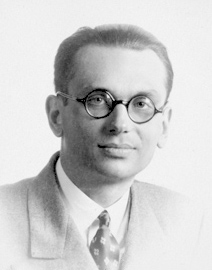 12 / 1906–1978
Kurt Gödel
Kurt Friedrich Gödel (1906–1978) was born in Brünn, then part of Austria-Hungary (now Brno), and was one of the most influential figures in mathematical logic and analytical philosophy. From an early age, he showed intense curiosity and exceptional abilities, beginning his studies in Vienna with the aim of pursuing theoretical physics, but he was quickly won over by mathematics and especially logic. In 1929, he completed his doctoral thesis under Hans Hahn, proving the Completeness Theorem of first-order predicate logic, i.e., the deep connection between provability (syntax) and truth in models (semantics). Shortly thereafter, he published his famous Incompleteness Theorems, which forever changed the picture of the foundations of mathematics: they showed that any consistent axiomatic system containing elementary arithmetic cannot be complete and, moreover, cannot prove its own consistency. With the rise of Nazism, he gradually found himself in the US and settled at the Institute for Advanced Study in Princeton, where he became close friends with Albert Einstein and also worked on ideas related to relativity. In set theory, he also gave fundamental consistency results for the Axiom of Choice and the Continuum Hypothesis in relation to the ZF axioms, paving the way for Cohen's later work on their independence. In the last years of his life, he suffered greatly from psychological problems and died in 1978.Although his life had tragic aspects, his scientific legacy remains enormous: after Gödel, no one can talk about a "complete" foundation of mathematics in the same naive way as before.


